
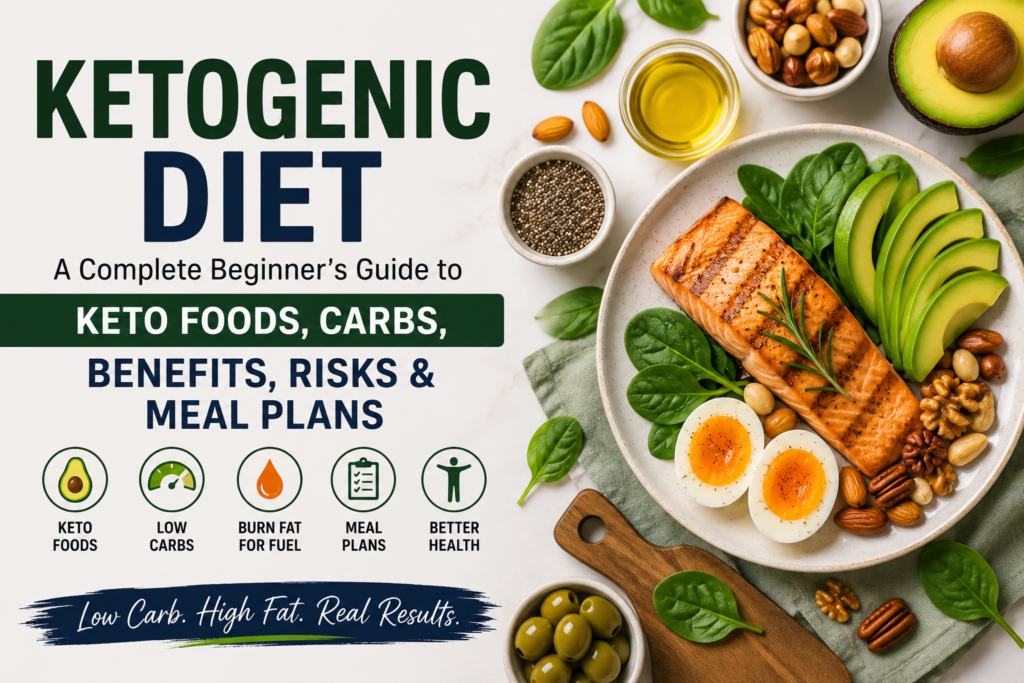
Ketogenic Diet: A Complete Beginner’s Guide to Keto Foods, Carbs, Benefits, Risks & Meal Plans
- Have you ever wondered why the ketogenic diet has become so popular?
- Maybe you’ve heard people talking about keto diet foods, counting carbs, losing weight, or following a strict ketogenic diet plan. You may also have come across terms such as the ketovore diet, high-protein ketogenic diet, or even the paleo diet and wondered how they are connected.
- The truth is that keto is more than simply “eating fewer carbohydrates.”
- A properly planned ketogenic diet changes the balance of carbohydrates, fat, and protein in your diet enough to encourage the body to produce ketones and use more fat as an energy source.
- But there is also a lot of confusion surrounding keto.
- Is keto healthy?
How many carbs can you eat?
What foods are allowed?
Can keto help with weight loss?
Is the ketogenic diet useful for epilepsy?
What about cancer or mental health?
And is keto actually different from a ketogenic diet? - This guide answers those questions in simple language while explaining how to create a practical keto diet plan.
Important: This article is for educational purposes. A strict ketogenic diet can affect blood glucose, medications, nutrition, and other aspects of health. If you have a medical condition, take medication, are pregnant or breastfeeding, or want to use keto therapeutically, speak with a qualified healthcare professional or registered dietitian.
Table of Contents
What Is the Ketogenic Diet?
- The ketogenic diet, commonly called the keto diet, is a very low-carbohydrate, high-fat eating pattern with moderate protein.
- The main goal is to reduce carbohydrate intake enough to encourage the body to enter a metabolic state called ketosis.
- Normally, carbohydrates are broken down into glucose, which the body can use as a major source of energy. When carbohydrate availability becomes very low, the liver begins producing ketone bodies from fat.
- These ketones can then be used as an alternative fuel source.
- A simple way to understand it is:
- Less carbohydrate → lower glucose availability → greater reliance on fat → increased ketone production
- A strict ketogenic diet often limits carbohydrates to around 20–50 grams per day, although individual requirements and responses can vary.
Ketogenic Diet Meaning: What Does Keto Actually Mean?
- The simplest ketogenic diet meaning is:
A ketogenic diet is an eating pattern designed to keep carbohydrate intake very low so the body produces ketones and relies more heavily on fat for fuel.
- This doesn’t mean that every low-carb diet is ketogenic.
- For example, someone could reduce their bread, rice, and sugar intake but still consume enough carbohydrates to remain outside nutritional ketosis.
- That’s why keto is generally more restrictive than a typical low-carb diet.
How Does the Keto Diet Work?
The body usually gets a significant amount of its energy from glucose.
When you eat foods containing carbohydrates, such as:
- Rice
- Bread
- Pasta
- Potatoes
- Sugar
- Cereals
- Many fruits
your body breaks down carbohydrates into glucose.
When carbohydrate intake is drastically reduced, the body has less glucose available from food.
The liver responds by producing ketones from fat.
This metabolic shift is the foundation of the keto diet.
However, entering ketosis doesn’t automatically mean that every person will lose weight.
Weight loss still depends on your overall energy intake, food choices, activity, appetite, sleep, and how sustainable your eating pattern is.
How Many Carbs on Keto Can You Eat?
- One of the most searched questions is:
- How many carbs on keto are actually allowed?
- There isn’t one universal number for everyone.
- However, many ketogenic diets use approximately 20–50 grams of carbohydrates per day. Harvard Health describes this range as typical for achieving ketosis, while noting that individual needs can vary.
Examples of higher-carbohydrate foods
| Food | Why it can be difficult on strict keto |
|---|---|
| Rice | High in carbohydrates |
| Bread | Concentrated carbohydrate source |
| Pasta | High carbohydrate content |
| Potatoes | Starchy vegetable |
| Sugary drinks | High in rapidly absorbed carbohydrates |
| Candy | Mostly added sugar |
| Cakes | Sugar + flour |
| Large portions of fruit | Can provide substantial carbohydrate |
- This doesn’t mean these foods are automatically “bad.”
- It simply means that they may not fit easily into a strict ketogenic eating pattern.
Total Carbs vs Net Carbs
- You may also hear keto followers talking about net carbs.
- A commonly used calculation is:
- Net carbs = total carbohydrates − fiber
- However, nutrition labeling can vary by country and product, and different keto plans use different approaches.
- If you’re following keto for a medical reason, don’t rely on internet calculators alone. Follow the carbohydrate targets provided by your healthcare team.
Keto Diet Foods: What Can You Eat?
A well-planned keto diet can include a surprisingly wide range of foods.
Eggs
Eggs are one of the easiest keto-friendly foods.
You can prepare them as:
- Boiled eggs
- Scrambled eggs
- Omelets
- Egg muffins
- Egg salad
Adding vegetables can make an egg-based meal more nutritious and filling.
Fish and Seafood
Fish can be an excellent choice because it provides protein, and fatty fish such as salmon, sardines, and mackerel also provide omega-3 fats.
Good choices include:
- Salmon
- Sardines
- Tuna
- Mackerel
- Trout
- Shrimp
Chicken and Meat
Depending on your preferences, keto meals can include:
- Chicken
- Turkey
- Beef
- Lamb
- Pork
But there is an important point:
Low-carb does not automatically mean healthy.
Eating mostly processed meat simply because it contains few carbohydrates is not the best way to build a nutritious diet.
Low-Carb Vegetables
Vegetables should not disappear from your plate just because you’re following keto.
Common choices include:
- Spinach
- Broccoli
- Cauliflower
- Cucumber
- Zucchini
- Mushrooms
- Cabbage
- Lettuce
- Asparagus
- Kale
- Bell peppers
These foods can provide fiber, vitamins, minerals, and volume.
Avocado
Avocado is popular among people following keto because it contains fat and fiber while fitting relatively easily into a low-carbohydrate eating pattern.
Try it with eggs, salads, chicken, or fish.
Nuts and Seeds
Depending on your carbohydrate target and portion size, you can include:
- Almonds
- Walnuts
- Macadamia nuts
- Chia seeds
- Flaxseeds
- Pumpkin seeds
Because these foods are calorie-dense, portion size still matters.
Ketogenic Diet Food List
- Here is a simple ketogenic diet food list for beginners.
| Category | Examples |
|---|---|
| Eggs | Boiled, scrambled, omelet |
| Fish | Salmon, tuna, sardines, mackerel |
| Meat | Chicken, beef, lamb, pork |
| Vegetables | Spinach, broccoli, cauliflower, zucchini |
| Healthy fats | Olive oil, avocado |
| Nuts | Almonds, walnuts, macadamia nuts |
| Seeds | Chia, flax, pumpkin seeds |
| Dairy | Plain Greek yogurt, cheese, cottage cheese |
| Seafood | Shrimp, prawns, shellfish |
| Lower-carb fruit | Small portions of berries |
The goal isn’t to eat every food on this list every day.
- Instead, use it as a starting point for creating balanced meals.
Foods to Limit or Avoid on Keto
A strict keto diet significantly limits many carbohydrate-rich foods.
These commonly include:
- Sugary drinks
- Candy
- Cakes
- Cookies
- Bread
- Pasta
- Rice
- Breakfast cereals
- Potatoes
- Sweetened sauces
- Many desserts
You should also watch for hidden carbohydrates in packaged foods.
For example, a sauce or flavored yogurt may appear harmless but contain added sugar.
Reading nutrition labels can therefore become an important part of following keto.
What Is a Ketovore Diet?
The ketovore diet is a relatively newer term used to describe an eating pattern that combines ketogenic principles with a strong emphasis on animal-based foods.
It commonly focuses on:
- Meat
- Fish
- Eggs
- Animal-based foods
- Very low carbohydrate intake
Some versions include small amounts of low-carb vegetables, while others are much more restrictive.
The key difference is that a conventional ketogenic diet can include a broader variety of plant foods, including vegetables, nuts, seeds, and avocado.
Is ketovore better than keto?
Not necessarily.
A more restrictive diet isn’t automatically a healthier diet.
One concern with heavily restricting plant foods is that it can become more difficult to obtain enough fiber and a wide range of micronutrients.
What Is a High-Protein Ketogenic Diet?
- A high-protein ketogenic diet is a variation of keto that places greater emphasis on protein.
- This may sound simple, but there is an important distinction:
- Traditional keto is not simply a high-protein diet.
- The classic ketogenic approach is built around very low carbohydrate intake, high fat, and an appropriate amount of protein.
- Eating extremely large amounts of protein may make it harder for some people to maintain ketosis.
- So if you’re trying to follow a ketogenic diet, increasing protein without considering your overall carbohydrate and fat intake may change the diet significantly.
Ketogenic Diet Plan: How to Build Your Meals
You don’t need complicated recipes to create a practical ketogenic diet plan.
Try this simple formula:
Step 1: Choose your protein
Pick one:
- Eggs
- Chicken
- Fish
- Beef
- Turkey
- Seafood
Step 2: Add low-carb vegetables
Choose one or two:
- Broccoli
- Spinach
- Cauliflower
- Zucchini
- Cucumber
- Mushrooms
Step 3: Add a healthy fat
For example:
- Olive oil
- Avocado
- Nuts
- Seeds
Step 4: Check your carbohydrate sources
Look carefully at:
- Sauces
- Dressings
- Drinks
- Snacks
- Packaged foods
This simple structure can make keto meal planning much easier.
7-Day Keto Menu Example
Here’s a beginner-friendly keto menu example.
| Day | Breakfast | Lunch | Dinner |
|---|---|---|---|
| Monday | Eggs + spinach | Chicken salad + avocado | Salmon + broccoli |
| Tuesday | Vegetable omelet | Tuna + cucumber salad | Chicken + cauliflower |
| Wednesday | Boiled eggs + avocado | Grilled fish + salad | Beef + zucchini |
| Thursday | Eggs + mushrooms | Chicken lettuce bowl | Salmon + asparagus |
| Friday | Plain Greek yogurt + berries | Tuna-avocado salad | Grilled chicken + broccoli |
| Saturday | Omelet + spinach | Fish salad | Beef + cauliflower |
| Sunday | Eggs + avocado | Chicken salad | Fish + green vegetables |
This is an example, not a personalized medical diet plan.
Portion sizes should be based on individual energy needs, health goals, and nutritional requirements.
Keto Diet Advantages and Disadvantages
Before starting keto, it’s worth looking at both sides.
Potential Advantages
Weight Loss
A ketogenic diet can help some people lose weight, particularly in the short term.
Reduced carbohydrate intake may also reduce intake of highly processed foods and may influence appetite.
However, long-term success depends heavily on whether a person can maintain the diet.
Blood Sugar Control
Reducing carbohydrate intake can improve blood glucose levels for some people.
But this can also create a medication-management issue for people taking glucose-lowering drugs.
Anyone using diabetes medication should discuss significant dietary changes with their healthcare professional.
Established Medical Use in Epilepsy
The ketogenic diet has a well-established role as a medical nutrition therapy for some people with epilepsy, especially when seizures are not adequately controlled with medication.
This therapeutic ketogenic diet is much more carefully controlled than the casual keto diets commonly discussed online.
Potential Disadvantages
Nutrient Gaps
A restrictive diet can make it harder to consume a wide range of nutrients.
Constipation
Reducing grains, legumes, fruits, and other carbohydrate-containing foods without replacing their fiber can contribute to constipation.
Increased LDL Cholesterol
Some people experience increases in LDL cholesterol on ketogenic diets, particularly when the diet is high in saturated fat.
Difficulty Maintaining the Diet
Keto can be socially and practically challenging because many common foods are restricted.
Possible Side Effects
Some people experience fatigue, headaches, constipation, nausea, or other symptoms when they first make a major carbohydrate reduction.
Ketogenic Diet and Epilepsy
The connection between the ketogenic diet and epilepsy is one of the most medically established uses of ketogenic dietary therapy.
A carefully formulated ketogenic diet can reduce seizures in some children and adults with epilepsy, particularly when medications do not provide adequate control. Mayo Clinic notes that this approach should be carried out under close professional supervision.
This is very different from simply following an internet keto meal plan.
Medical ketogenic therapy may involve:
- Precise macronutrient ratios
- Monitoring
- Nutritional supplementation
- Medical supervision
- Regular follow-up
Possible side effects can include dehydration, constipation, nutritional problems, and kidney stones, which is another reason medical supervision matters.
Never replace prescribed epilepsy treatment with a self-directed keto diet.
Ketogenic Diet and Cancer: What Does the Research Say?
Searches for ketogenic diet cancer have become increasingly common.
The theory behind keto and cancer research is partly based on the fact that many cancer cells use glucose as an energy source. Researchers are studying whether changing metabolism through carbohydrate restriction and ketosis could have a therapeutic role in certain cancers.
But this is where it’s important to separate research from proven treatment.
The National Cancer Institute states that there is currently no proof that popular diets, including ketogenic diets, can slow, cure, or prevent cancer from returning. Researchers continue to study ketogenic diets in cancer settings, including glioblastoma and other cancers.
So the responsible conclusion is:
Keto should not be promoted as a cancer treatment.
If someone has cancer and is considering a ketogenic diet, it should be discussed with their oncologist and dietitian, especially because maintaining adequate nutrition and body weight can be critical during treatment.
Ketogenic Diet for Mental Health: Is It Proven?
- Another growing search topic is ketogenic diet for mental health.
- Researchers are investigating whether ketosis and changes in brain energy metabolism could influence conditions such as depression and anxiety.
- The evidence is interesting but still developing.
- A 2026 systematic review and meta-analysis found an association between ketogenic diets and modest improvements in depressive symptoms in randomized trials, but it found no significant association for anxiety and highlighted limitations such as study heterogeneity and short follow-up.
- Earlier reviews have also concluded that evidence for using ketogenic diets as established treatment for mood and anxiety disorders has been limited or low quality.
Therefore:
- Keto should not replace professional mental-health treatment or prescribed medication.
- More research is needed before ketogenic diets can be considered a standard treatment for mental-health conditions.
Keto Diet vs Paleo Diet
The paleo diet and ketogenic diet are sometimes confused because both can reduce highly processed foods.
But they have different rules.
| Feature | Keto Diet | Paleo Diet |
|---|---|---|
| Main goal | Nutritional ketosis | Focus on minimally processed foods inspired by ancestral eating |
| Carbohydrates | Very low | Not necessarily very low |
| Grains | Usually restricted | Restricted |
| Legumes | Usually restricted | Restricted |
| Fruit | Limited depending on carb target | Generally allowed |
| Dairy | Can be included | Usually excluded |
| Ketosis | Main objective | Not required |
| Fat | Often high | Varies |
So, paleo does not automatically mean keto.
A person can follow paleo without entering ketosis.
Ketogenic Diet vs Keto Diet: What’s the Difference?
This is actually very simple.
Ketogenic diet = keto diet
“Keto” is simply the commonly used short form of “ketogenic.”
So when someone searches for ketogenic diet vs keto diet, they are usually comparing two names for the same general dietary approach.
However, individual keto plans can vary significantly.
One person’s keto plan might emphasize whole foods, vegetables, fish, olive oil, and avocado.
Another person’s version might rely heavily on processed meat, cheese, butter, and packaged keto products.
Both may be called “keto,” but their nutritional quality can be very different.
Common Keto Mistakes Beginners Should Avoid
1. Thinking Keto Means Unlimited Fat
Keto is high in fat, but that doesn’t mean you should add unlimited butter, cheese, cream, and oil.
The type of fat matters.
2. Eating Too Much Processed Meat
Bacon, sausages, and processed meats may be low in carbohydrates, but they shouldn’t automatically become the foundation of your diet.
3. Avoiding All Vegetables
This is one of the biggest mistakes.
Low-carb vegetables can provide fiber and important micronutrients.
4. Ignoring Portion Sizes
A food can be keto-friendly and still contain a lot of calories.
Nuts, cheese, oils, cream, and fatty meats are good examples.
5. Depending Too Much on “Keto” Packaged Foods
A product labeled “keto” isn’t automatically nutritious.
Check the ingredient list and nutrition facts rather than relying only on the front-of-package label.
6. Expecting Instant Results
Your body needs time to adapt to a major carbohydrate reduction.
And weight loss isn’t perfectly linear.
Focus on sustainable habits rather than expecting dramatic changes within a few days.
Who Should Be Careful With a Ketogenic Diet?
Keto isn’t appropriate for everyone.
Talk with a healthcare professional before starting a strict ketogenic diet if you:
- Have diabetes and take glucose-lowering medication
- Have kidney disease
- Have liver disease
- Have a history of kidney stones
- Are pregnant or breastfeeding
- Have a history of disordered eating
- Take medications affected by major dietary changes
- Want to use keto as treatment for a medical condition
Harvard Health notes potential concerns involving nutrient deficiencies, liver and kidney issues, constipation, and LDL cholesterol, among other considerations.
Frequently Asked Questions About the Ketogenic Diet
1. What is the ketogenic diet meaning?
The ketogenic diet is a very low-carbohydrate, high-fat eating pattern designed to encourage the body to produce ketones and use more fat for energy.
2. What is keto?
“Keto” is simply a shortened name for the ketogenic diet.
3. How many carbs on keto can I eat?
Many keto plans use around 20–50 grams of carbohydrates per day, but individual needs and responses vary.
4. What are the best keto diet foods?
Common choices include eggs, fish, meat, avocado, olive oil, nuts, seeds, and low-carbohydrate vegetables.
5. What is a ketogenic diet food list for beginners?
A basic list can include eggs, chicken, fish, beef, leafy greens, broccoli, cauliflower, zucchini, avocado, olive oil, nuts, and seeds.
6. Can I eat rice on keto?
Regular rice is relatively high in carbohydrates and generally doesn’t fit easily into a strict ketogenic diet.
7. Is a high-protein ketogenic diet the same as regular keto?
Not exactly. Traditional keto emphasizes very low carbohydrates, high fat, and moderate protein. A high-protein version increases protein intake and may affect how easily some people maintain ketosis.
8. What is the ketovore diet?
The ketovore diet is a more animal-food-focused approach that combines ketogenic principles with elements of carnivore-style eating.
9. Is keto better than the paleo diet?
Neither is automatically better. They have different goals and restrictions. Keto focuses strongly on carbohydrate restriction and ketosis, while paleo focuses more on food selection.
10. Can keto help with weight loss?
It can help some people lose weight, especially in the short term, but long-term success depends on adherence, overall energy intake, food quality, and lifestyle.
11. Is the ketogenic diet good for epilepsy?
A medically supervised ketogenic diet can help reduce seizures in some people with epilepsy. It should be used under professional guidance.
12. Can keto cure cancer?
No. There is currently no evidence that a ketogenic diet can cure cancer. Keto is being studied as a possible complementary approach in some cancer settings, but it should not replace standard cancer treatment.
13. Is ketogenic diet for mental health scientifically proven?
Research is ongoing. Some recent evidence suggests possible benefits for depressive symptoms, but evidence for anxiety is inconclusive and keto is not an established replacement for mental-health treatment.
14. Can I eat vegetables on keto?
Absolutely. Low-carbohydrate vegetables such as spinach, broccoli, cauliflower, zucchini, cucumber, and mushrooms can be valuable parts of a keto diet.
15. Is every low-carb diet a ketogenic diet?
No. A person can eat fewer carbohydrates without reaching nutritional ketosis. Keto is generally much more restrictive.
Final Thoughts
- The ketogenic diet is much more than simply cutting out bread and sugar.
- It is a specific low-carbohydrate eating pattern designed to encourage ketosis. For some people, it can be a useful approach for weight management or metabolic goals. It also has an important medical role in certain cases of epilepsy under professional supervision.
- At the same time, keto isn’t a magic diet.
- The quality of your food choices matters. Eating low-carb processed foods all day is very different from building meals around fish, eggs, vegetables, avocado, nuts, seeds, and healthier fats.
- The same principle applies to the ketovore diet, high-protein ketogenic diet, and other keto variations: more restrictive doesn’t automatically mean more effective.
- And when it comes to searches such as ketogenic diet cancer or ketogenic diet for mental health, it’s especially important to distinguish promising research from established medical treatment.
- If you decide to try keto for general nutrition or weight management, focus on:
- Whole foods + adequate nutrition + appropriate portions + low carbohydrate intake + sustainability.
- And if you’re considering keto for a medical condition, involve a qualified healthcare professional rather than relying on social media advice.
Pingback: Best High Protein Foods: Top 25 Protein-Rich Foods
Pingback: Healthy Carbs vs Bad Carbs: Key Differences, Best Foods
Pingback: Vitamin D3 and B12 Deficiency: Symptoms & Foods
Pingback: 10 means Why Do I Always Feel Hungry? Causes & How to Stop