
Table of Contents
What Is an EMS Workout?
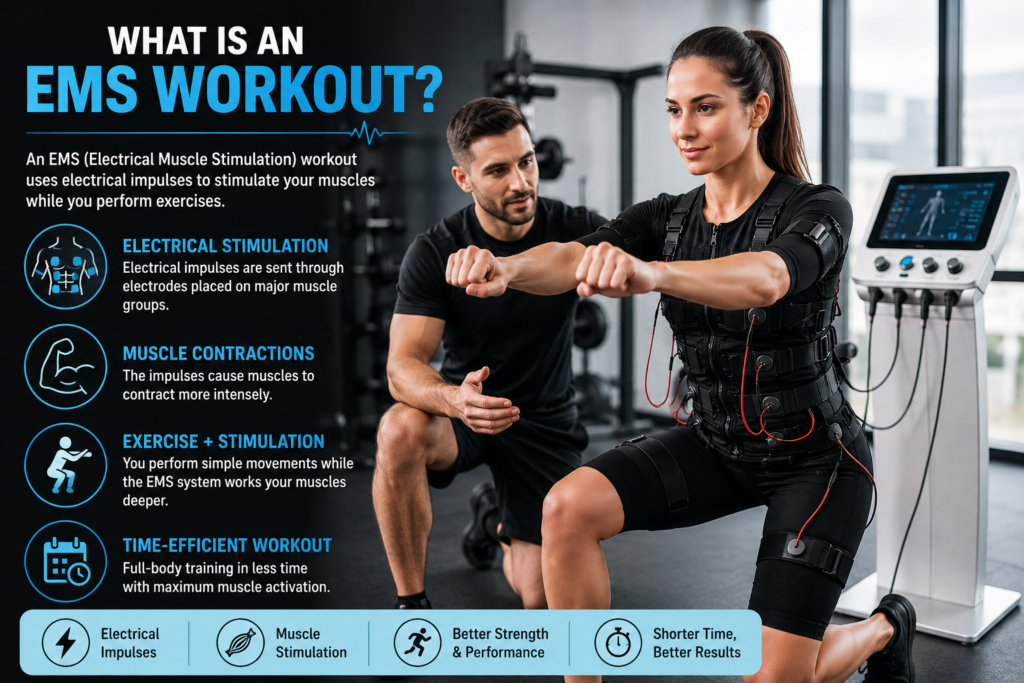
An EMS workout, or electrical muscle stimulation workout, is a type of fitness training that uses controlled electrical impulses to stimulate muscles while you perform simple movements or exercises.
EMS stands for Electrical Muscle Stimulation. In whole-body EMS training, electrodes are placed over major muscle groups such as the legs, glutes, abdomen, back, chest and arms. The electrical impulses create additional muscle contractions while you exercise.
Unlike traditional workouts, where your brain sends signals to your muscles through the nervous system, an EMS system uses an external device to provide electrical stimulation.
The idea sounds futuristic, but EMS technology has been used for years in areas such as physical therapy and muscle rehabilitation. More recently, whole-body EMS has become popular in commercial fitness studios.
Research suggests that properly supervised whole-body electromyostimulation can improve certain measures of muscle strength and function, although researchers also point out that the evidence is not strong enough to claim that EMS is superior to conventional exercise in every situation.
So, is EMS a replacement for your normal gym workout?
For most people, EMS is better viewed as an additional training method rather than a magic shortcut to fitness.
How Does EMS Workout Work?
During a typical EMS session, you wear a specially designed suit or vest containing electrodes.
The EMS workout machine sends controlled electrical impulses through these electrodes. These impulses stimulate the nerves that activate your muscles.
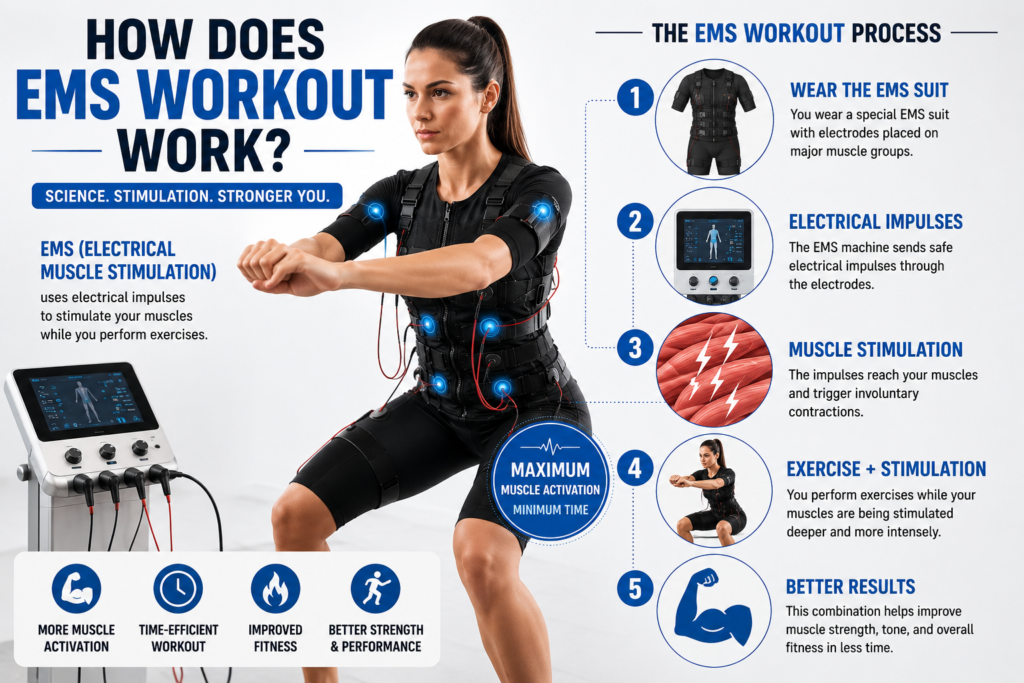
At the same time, you may perform movements such as:
- Squats
- Lunges
- Glute exercises
- Arm movements
- Core exercises
- Planks
- Light resistance exercises
The combination of voluntary movement and electrical stimulation is what makes an EMS training workout different from simply wearing an electrical stimulation device while sitting still.
The intensity can usually be adjusted for different muscle groups.
A professional trainer should gradually increase the intensity according to your experience, fitness level and tolerance rather than immediately using a high setting.
What Is an EMS Workout Suit?
An EMS workout suit is specially designed clothing used during whole-body electrical muscle stimulation training.
Depending on the system, the suit may include electrodes positioned around areas such as:
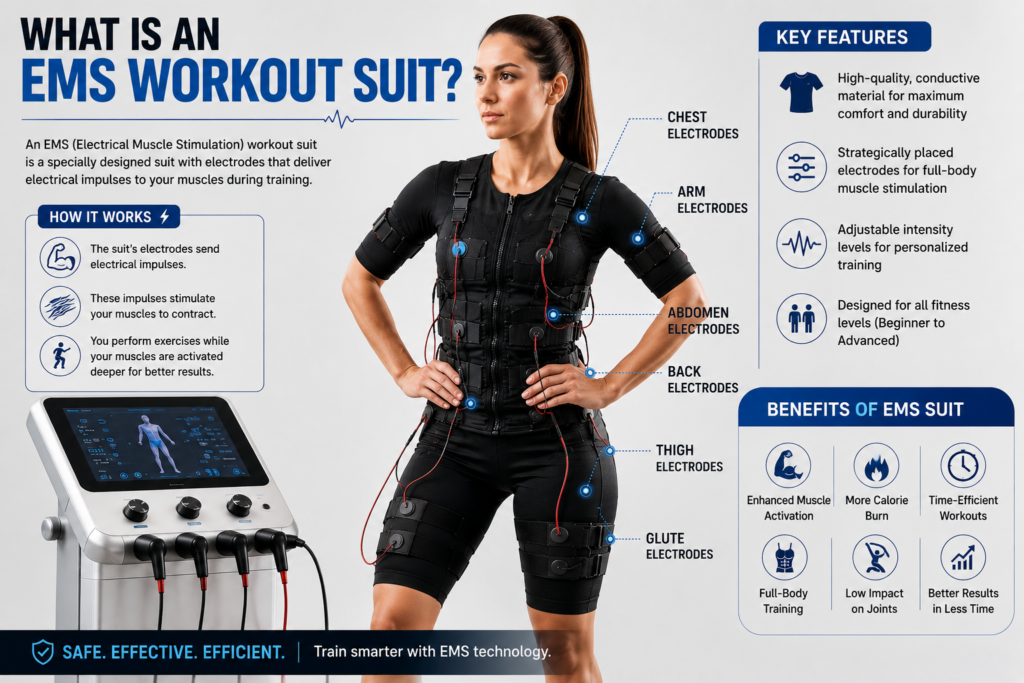
- Chest
- Upper back
- Lower back
- Abdomen
- Glutes
- Thighs
- Arms
The suit connects to an EMS workout machine that controls the electrical impulses.
One important point is that not every EMS suit is identical. Different manufacturers use different electrode designs, stimulation patterns, software and intensity controls.
Therefore, buying an EMS suit simply because it looks advanced does not automatically mean you will get better results.
The quality of the equipment, proper fitting, trainer supervision and training protocol are all important.
What Happens During an EMS Training Workout?
If you have never tried an EMS workout before, your first session may feel unusual.
A typical session can include several stages.
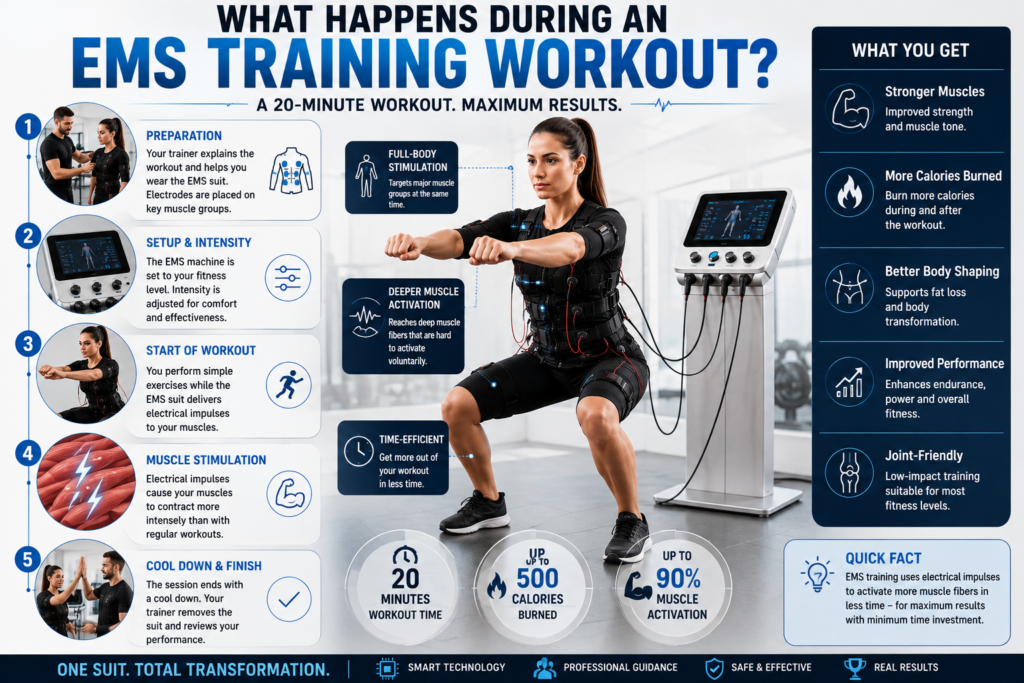
1. Consultation
The trainer may ask about your fitness experience, goals and relevant health considerations.
This step is important because EMS is not appropriate for everyone.
2. Putting on the EMS Suit
You wear the EMS suit according to the manufacturer’s instructions.
The electrodes need appropriate contact with the body so that stimulation can be delivered correctly.
3. Connecting the EMS Equipment
The suit is connected to the EMS workout machine.
The trainer can then control the stimulation intensity for different muscle groups.
4. Starting With Low Intensity
A beginner should not start with maximum intensity.
The trainer gradually introduces the stimulation while you become familiar with the sensation.
5. Performing Exercises
You may perform simple bodyweight movements while the muscles receive electrical stimulation.
6. Cool Down and Recovery
After the session, you may experience muscle fatigue or soreness, similar to other forms of exercise.
This is one reason why recovery should be taken seriously.
Benefits of EMS Workout
EMS workouts have attracted attention because they can provide muscle stimulation while requiring relatively short training sessions.
Here are some potential benefits.
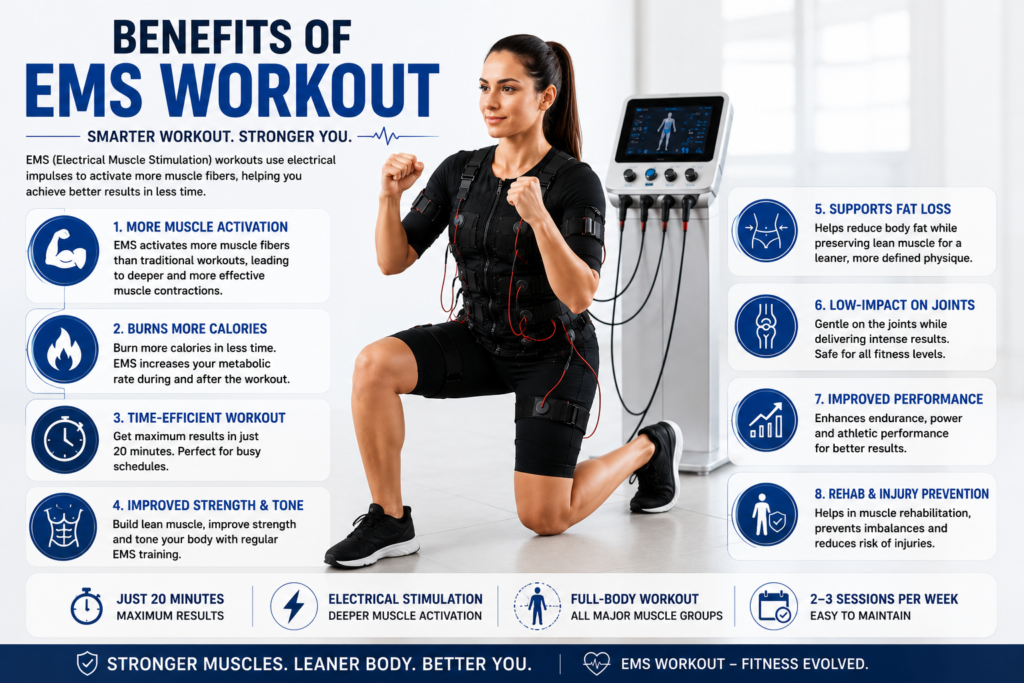
1. Muscle Strength Development
Research has found potential improvements in muscle strength and function following whole-body EMS training.
A 2023 systematic review and meta-analysis found positive effects of whole-body muscle stimulation on body composition and strength-related outcomes in adults. However, the researchers also noted that study protocols varied, so results should not be interpreted as a guarantee for every person.
This means EMS may be useful as part of a structured training program.
2. Time-Efficient Training
One reason people choose EMS is convenience.
A supervised session can be relatively short compared with a traditional gym session.
For someone with a busy schedule, this may make exercise easier to fit into the week.
However, shorter training time does not mean you should expect instant results.
Your overall activity level, nutrition, sleep and consistency still matter.
3. Full-Body Muscle Stimulation
A properly designed EMS body workout can stimulate several major muscle groups during the same session.
Instead of focusing on only one area, whole-body EMS can target multiple muscle groups simultaneously.
This is one of the reasons EMS is often promoted as a full-body training method.
4. Low-Impact Exercise Option
Many EMS workouts use simple bodyweight movements instead of heavy weights.
For some people, this can make EMS an attractive option when they want resistance-style training without performing large amounts of heavy lifting.
However, whether EMS is suitable for someone with an injury or medical condition should be determined with an appropriate healthcare professional.
5. Muscle Activation
Electrical stimulation can cause muscles to contract.
This is one of the fundamental principles behind EMS technology.
However, muscle activation should not be confused with automatically burning large amounts of body fat.
The body’s response depends on the overall training program.
Can EMS Workout Help With Weight Loss?
This is one of the most common questions about EMS.
The short answer is:
EMS may support a fitness and body-composition program, but it should not be considered a magic weight-loss treatment.
This distinction is important.
Some EMS advertisements make dramatic claims about losing large amounts of weight or fat simply by using an EMS machine.
Those claims should be approached carefully.
The FDA states that electrical muscle stimulators may produce some muscle strengthening or toning effects, but it has not cleared EMS devices specifically for weight loss, girth reduction or creating “six-pack” abdominal muscles.
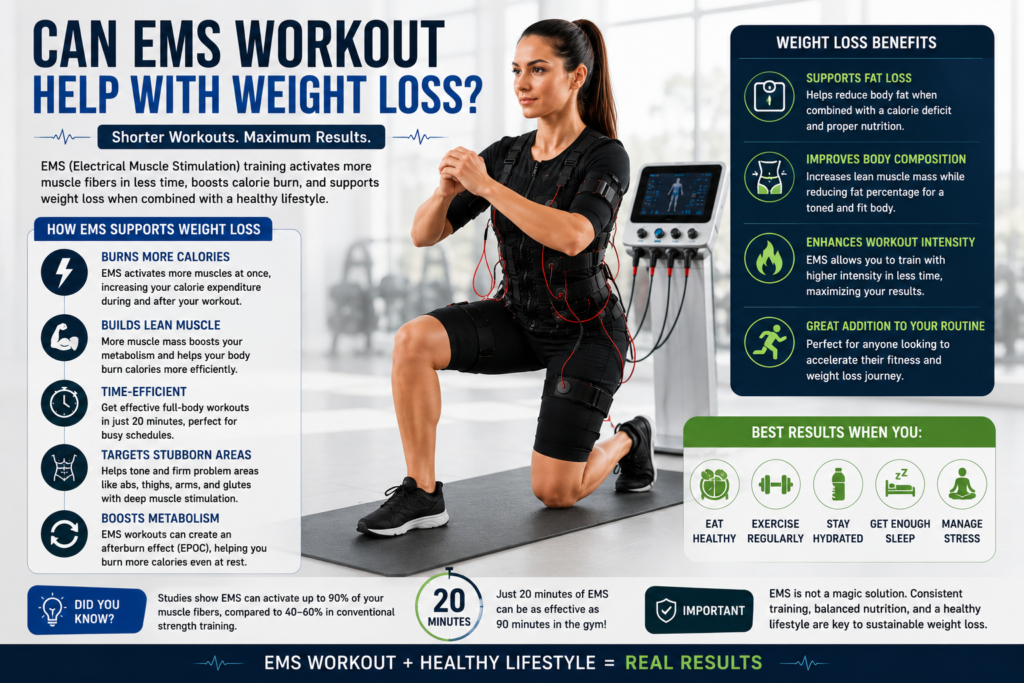
For meaningful fat loss, you still need to consider:
- Overall calorie intake
- Protein and nutrient intake
- Daily physical activity
- Resistance training
- Cardiovascular activity
- Sleep
- Stress
- Long-term consistency
Think of EMS as one tool in your fitness toolbox, not the entire toolbox.
EMS Workout Before and After: What Results Can You Expect?
Searching for EMS workout before and after pictures is common because people want to know how quickly results appear.
But before-and-after photographs can be misleading.
Lighting, posture, hydration, clothing, muscle pump and camera angle can make a major difference.
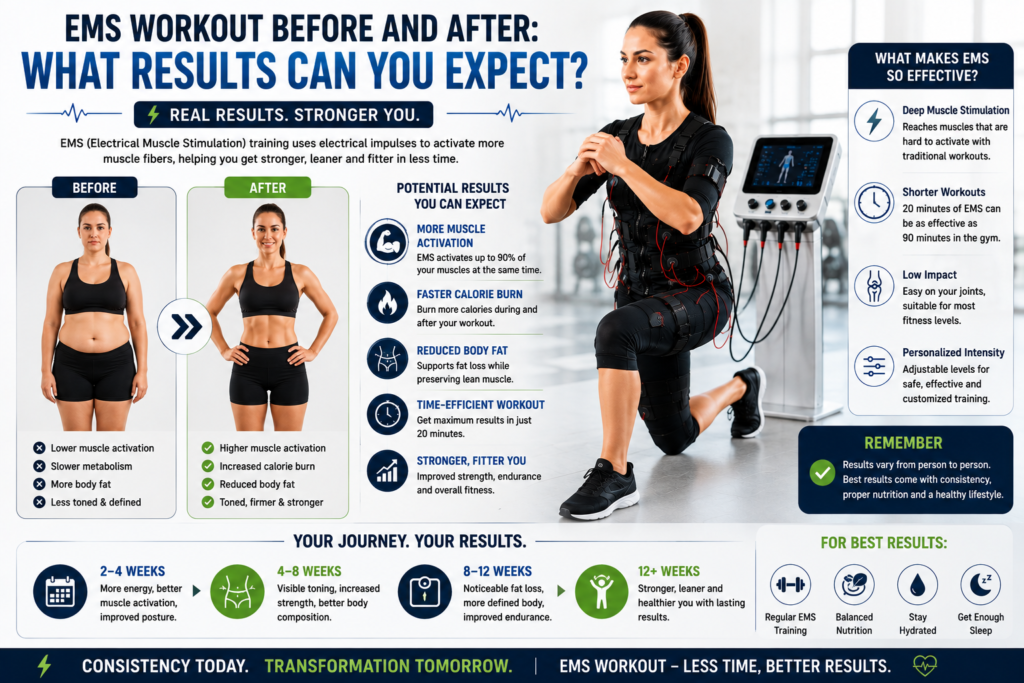
Your personal results will depend on factors such as:
- Starting fitness level
- Body composition
- Diet
- Training consistency
- EMS protocol
- Exercise selection
- Recovery
- Genetics
- Sleep
Some people may notice changes in muscle strength or body composition over time, while others may see more gradual changes.
Instead of judging progress only by photographs, consider tracking:
Strength → Measurements → Body composition → Fitness performance → Energy → Consistency
A realistic fitness transformation generally takes time.
EMS Workout vs Traditional Exercise
EMS and traditional exercise are not necessarily competitors.
They can serve different purposes.
| Feature | EMS Workout | Traditional Exercise |
|---|---|---|
| Muscle stimulation | Electrical + voluntary contraction | Voluntary contraction |
| Equipment | EMS suit and machine may be required | Often minimal equipment |
| Training duration | Often relatively short | Can range from short to long |
| Strength training | Possible | Excellent |
| Cardio training | Limited depending on protocol | Excellent |
| Skill development | Limited | Can be extensive |
| Convenience | High in supervised studios | Very flexible |
| Long-term fitness | Best as part of a complete program | Strong foundation |
A recent systematic review published in 2026 found that WB-EMS may positively influence maximum strength and power in athletes, but results varied by how EMS was applied, and some comparisons with traditional resistance training showed largely equivalent outcomes.
The takeaway?
EMS can be useful, but traditional exercise remains extremely valuable.
What Is EMS Workout Equipment?
EMS workout equipment generally includes several components.
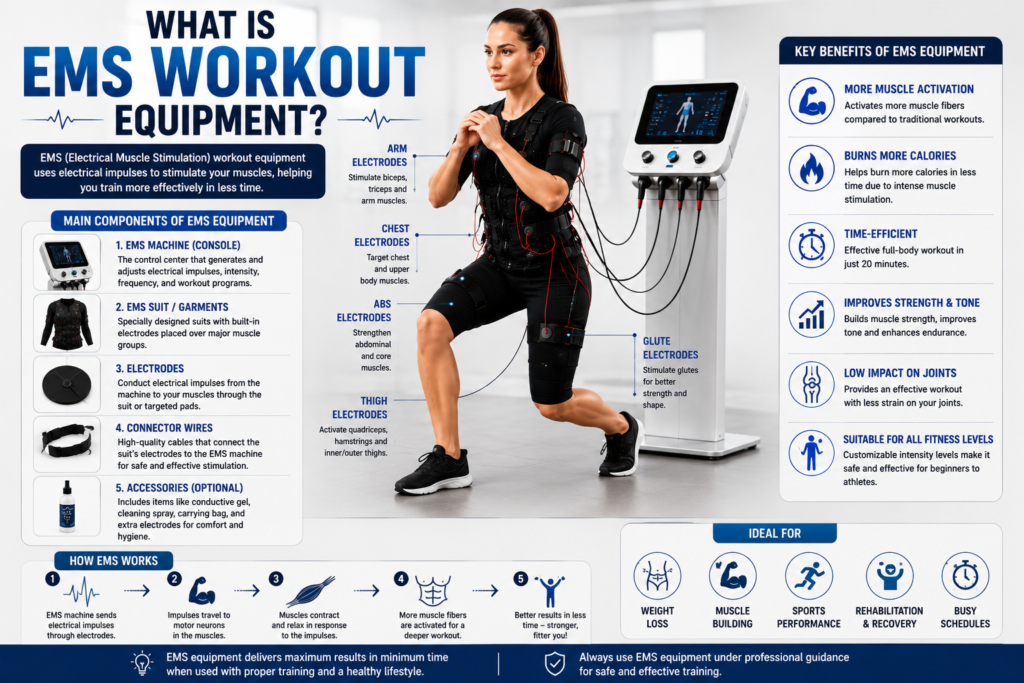
EMS Suit
The suit contains electrodes that contact different muscle groups.
EMS Workout Machine
The machine generates and controls the electrical impulses.
Control System
Modern systems may allow trainers to adjust stimulation intensity for different body areas.
Training Accessories
Some studios combine EMS with:
- Resistance bands
- Mats
- Bodyweight exercises
- Small weights
- Functional movements
The equipment should be used according to the manufacturer’s instructions and preferably under trained supervision.
How Does an EMS Workout Machine Work?
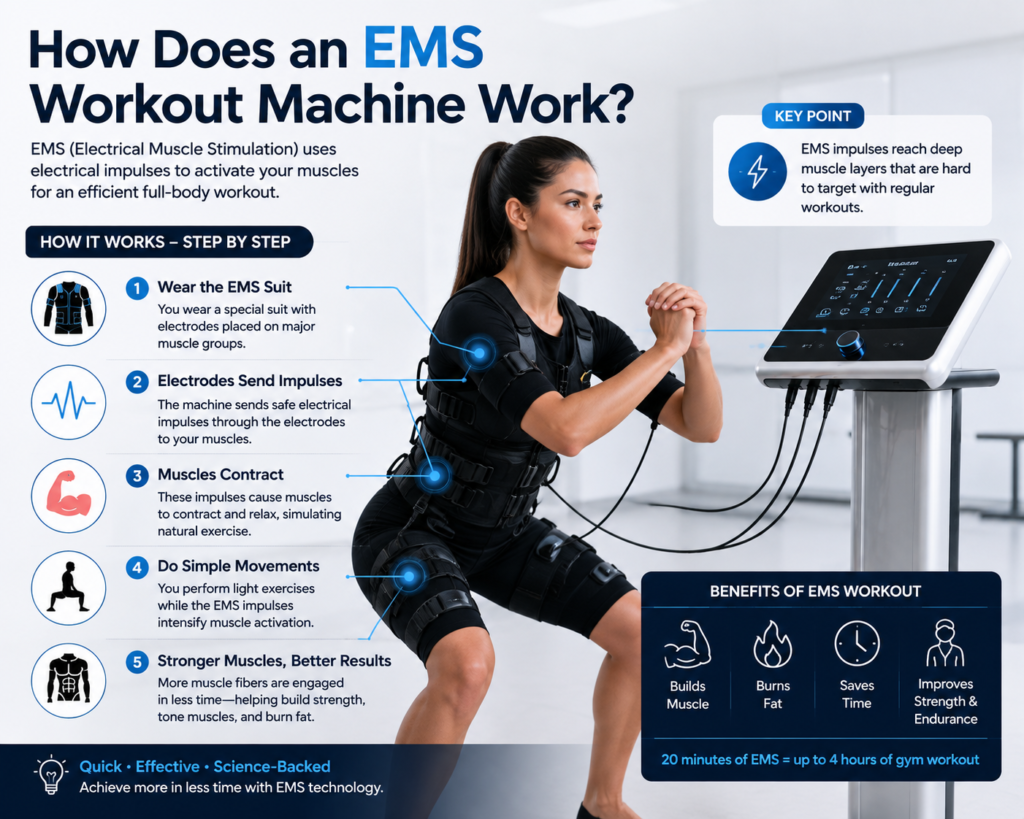
An EMS workout machine sends controlled electrical signals to electrodes placed on the body.
The electrical signal stimulates nerves and can cause the associated muscles to contract.
Different machines may provide different programs and settings.
For example, a trainer may be able to adjust stimulation for:
- Legs
- Glutes
- Abdomen
- Back
- Arms
- Chest
The important factor is not simply how powerful the machine is.
More intensity does not automatically mean better results.
Proper programming and gradual progression are more important than chasing the highest possible stimulation level.
Who Can Try EMS Workouts?
EMS workouts may appeal to:
- Busy professionals
- People looking for time-efficient training
- Fitness enthusiasts
- People interested in alternative training methods
- Athletes interested in supplementary training
- People who dislike conventional gym routines
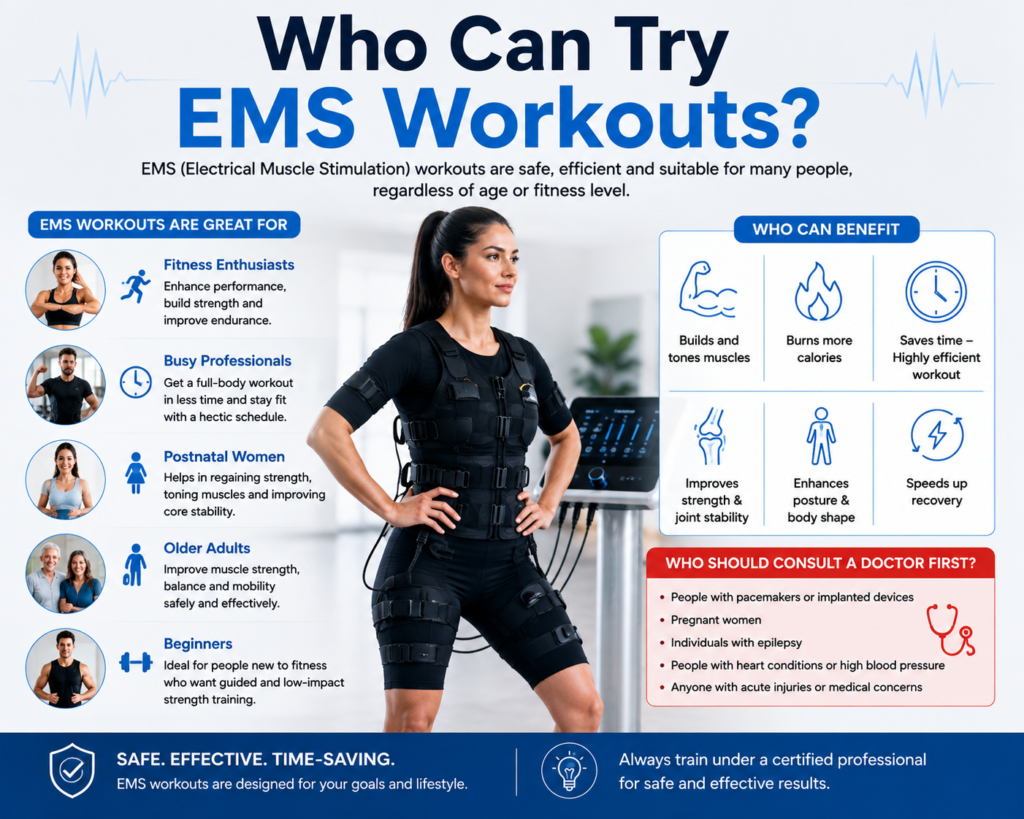
However, EMS is not automatically appropriate for everyone.
People with certain medical conditions or implanted electronic devices may need to avoid electrical stimulation or obtain medical advice before using it.
The FDA has specifically reported concerns involving electrical muscle stimulators, including skin irritation, burns, pain and interference with implanted devices such as pacemakers or defibrillators.
If you have a medical condition, are pregnant, have an implanted electronic device, or are unsure whether EMS is suitable for you, speak with your doctor or another qualified healthcare professional before starting.
EMS Workout Safety and Possible Risks
Safety should be one of the biggest considerations when starting EMS.
A 2023 international position statement emphasizes that WB-EMS has substantial metabolic and musculoskeletal effects and therefore requires appropriate preparation, application and safety procedures.
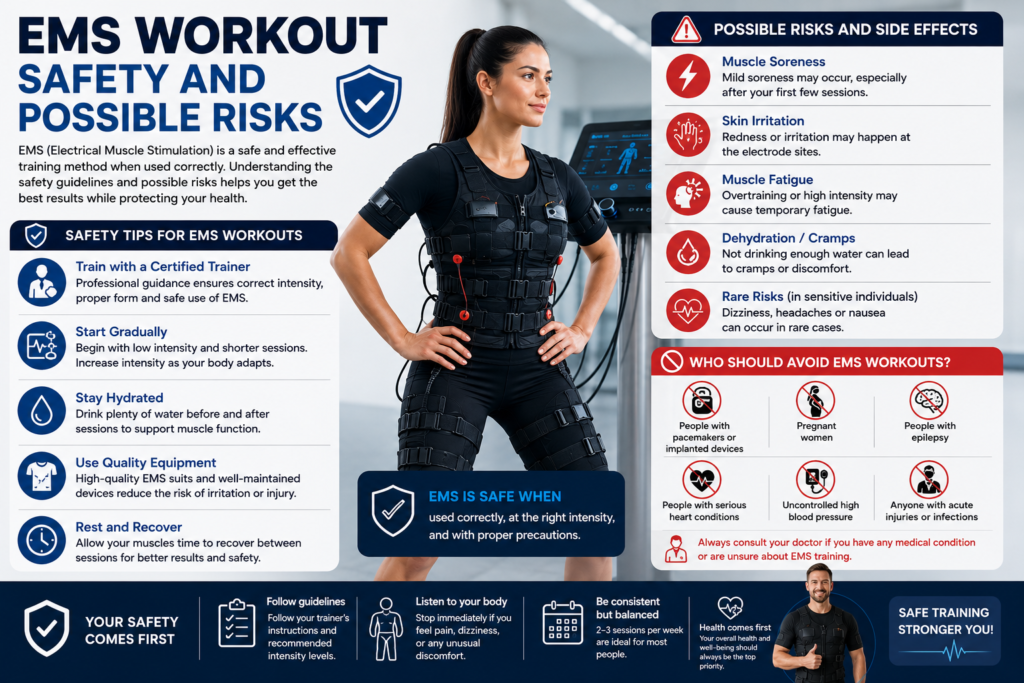
Potential problems from inappropriate use can include:
- Excessive muscle soreness
- Skin irritation
- Pain
- Burns
- Bruising
- Excessive muscle damage
The FDA has received reports of shocks, burns, bruising, skin irritation and pain associated with some EMS devices.
Never Assume More Is Better
One common beginner mistake is thinking:
Higher electrical intensity = better workout.
That is not a safe assumption.
A professional trainer should help you find an appropriate intensity and progress gradually.
How Often Should You Do EMS Training?
There is no single schedule that works for everyone.
The appropriate frequency depends on:
- Your fitness level
- EMS intensity
- Training experience
- Recovery
- Exercise selection
- Overall weekly activity
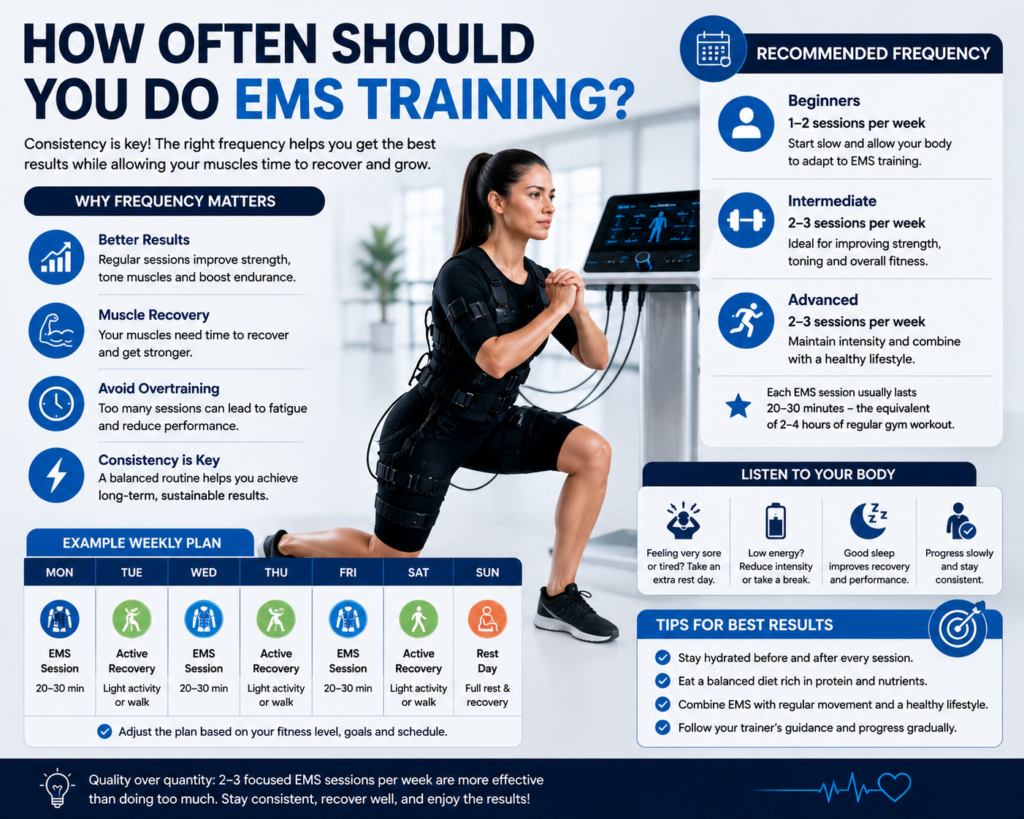
Because EMS can create significant muscle stimulation, beginners should avoid treating it like something they need to perform every day.
A qualified EMS trainer can create a schedule based on your individual circumstances and the specific equipment being used.
Recovery is part of training—not time wasted between workouts.
Tips for Getting Better EMS Workout Results
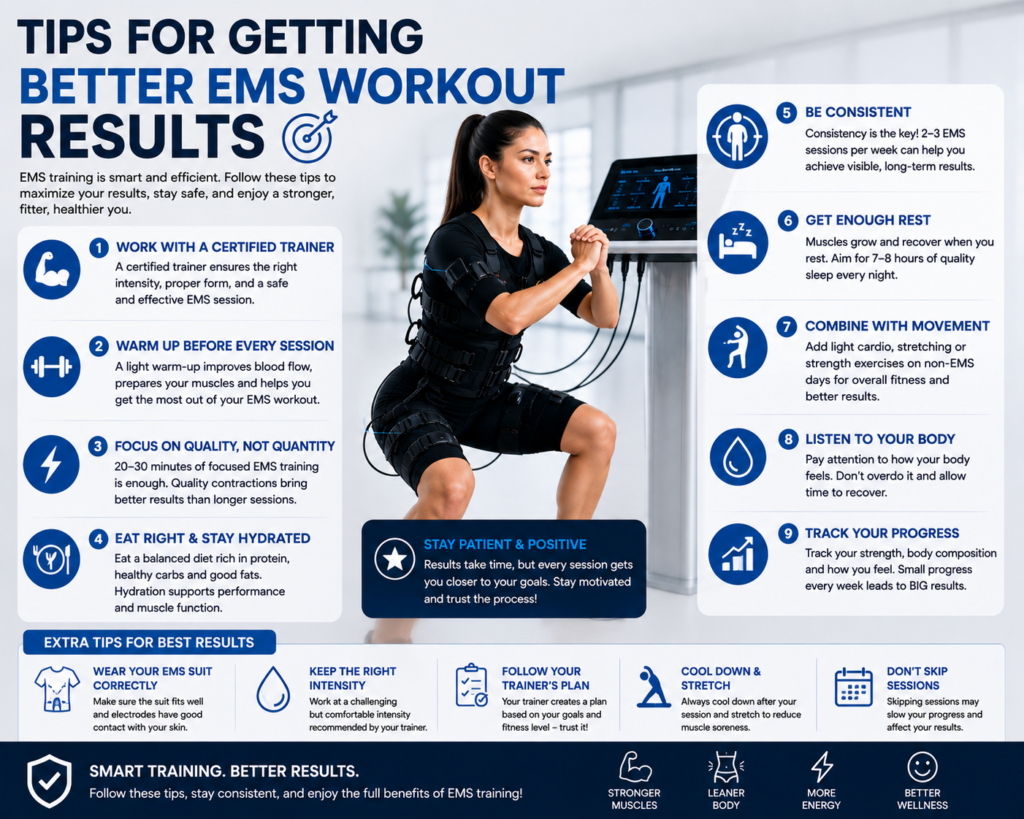
If you decide to try an EMS training workout, keep these principles in mind.
1. Choose Supervised Training
Especially if you are a beginner, learn the technique from a qualified professional.
2. Start Gradually
Your body needs time to adapt.
3. Focus on Movement Quality
Do not rush through exercises simply because the EMS machine is working.
4. Stay Hydrated
Hydration is an important part of general exercise recovery.
5. Eat Enough Protein
Protein supports muscle repair and recovery as part of an overall balanced diet.
6. Sleep Properly
Muscle recovery doesn’t stop when the workout ends.
7. Track Your Progress
Record measurements, strength, fitness performance and how you feel.
8. Don’t Ignore Recovery
If you experience unusual or severe pain, stop and seek appropriate professional advice.
Common EMS Workout Mistakes to Avoid
Mistake 1: Expecting Instant Fat Loss
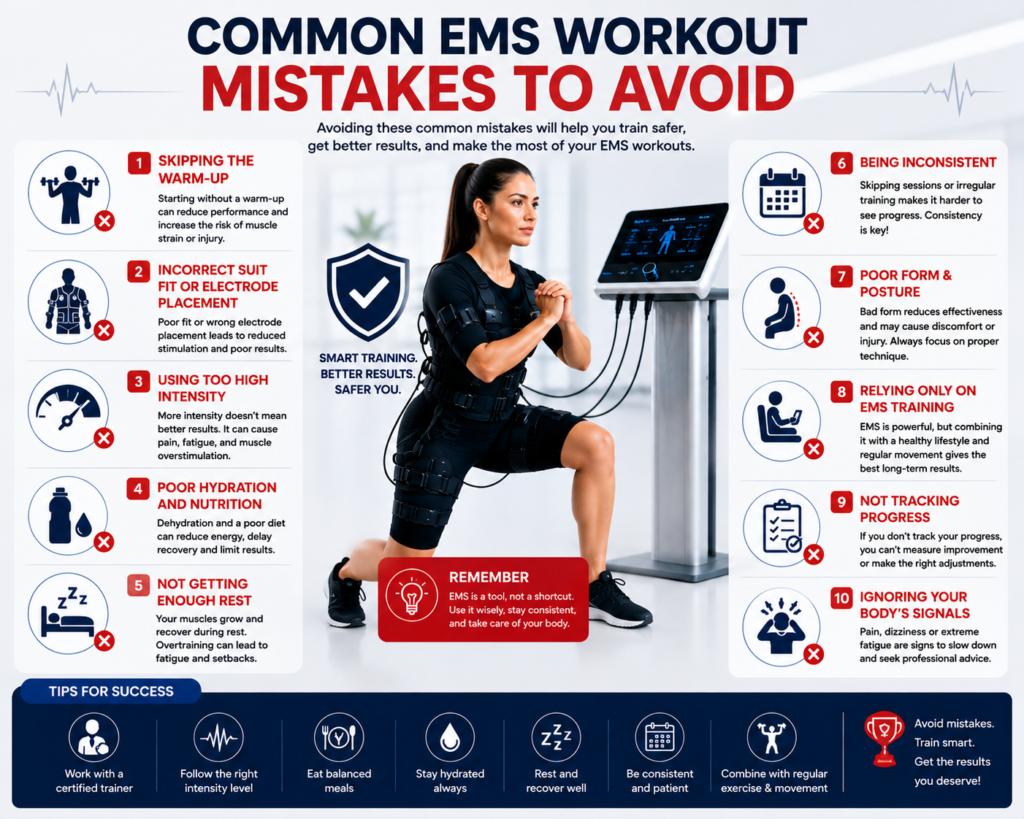
EMS is not a shortcut that eliminates the need for nutrition and physical activity.
Mistake 2: Using Maximum Intensity Immediately
Beginners should build up gradually.
Mistake 3: Buying Cheap Equipment Without Research
Check the manufacturer’s instructions, regulatory status where applicable, safety information and professional guidance.
Mistake 4: Ignoring Contraindications
Electrical stimulation isn’t suitable for everyone.
Mistake 5: Doing EMS Every Day
More training isn’t automatically better.
Mistake 6: Comparing Yourself With Social Media Photos
Online transformations don’t always show the complete story.
Mistake 7: Replacing All Exercise With EMS
Walking, resistance training, cardiovascular exercise, mobility work and daily movement all have important roles in a balanced fitness program.
EMS Workouts: Are They Worth Trying?
For the right person, EMS workouts can be an interesting addition to a fitness routine.
The strongest argument for EMS is not that it is a magical replacement for exercise.
Instead, its potential advantages include time efficiency, simultaneous muscle stimulation and an alternative way to perform resistance-style training.
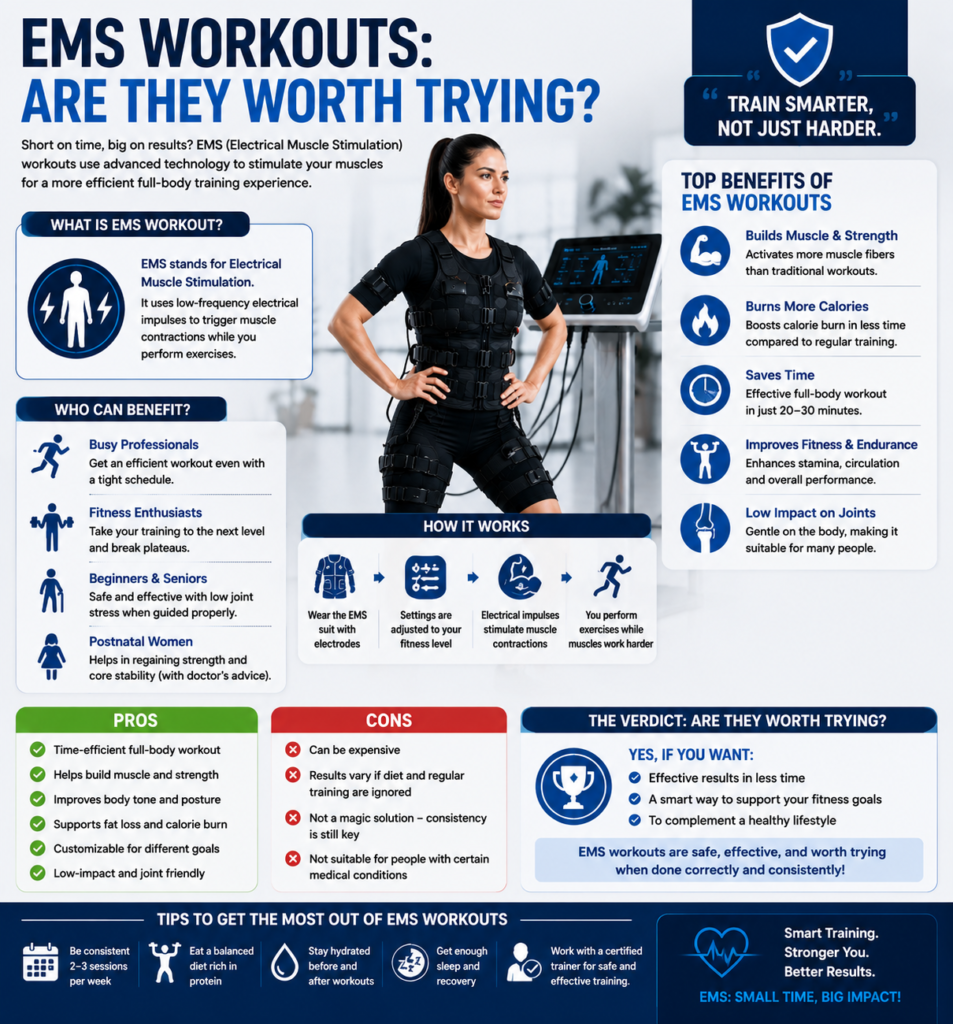
Scientific research supports potential benefits for muscle strength and function, but the evidence is still developing and study protocols differ.
Therefore, expectations should remain realistic.
If your goal is:
Muscle strength: EMS may help as part of a structured program.
Weight loss: Nutrition and overall physical activity remain essential.
General fitness: Traditional exercise should still have an important role.
Convenience: EMS may be attractive when time is limited.
Frequently Asked Questions About EMS Workout
1. What is an EMS workout?
An EMS workout uses electrical impulses to stimulate muscles while you perform physical movements or exercises. Whole-body EMS can stimulate several major muscle groups during a session.
2. Does EMS workout really work?
Research suggests that properly supervised whole-body EMS can improve some measures of muscle strength, muscle mass and physical function. However, results vary and EMS should not be viewed as a guaranteed shortcut.
3. What is an EMS workout suit?
An EMS workout suit is specialized clothing containing electrodes that deliver electrical stimulation to selected muscle groups.
4. Can EMS help burn belly fat?
EMS should not be marketed as a standalone solution for belly-fat reduction. The FDA states that EMS devices have not been cleared for weight loss, girth reduction or spot reduction.
5. Is EMS better than the gym?
Not necessarily. EMS and traditional exercise are different training approaches. Traditional resistance and cardiovascular exercise remain important components of overall fitness.
6. How long is an EMS workout?
Many commercial EMS sessions are relatively short, but session duration varies by equipment, protocol and trainer. Follow the specific program recommended by a qualified professional.
7. Can beginners do EMS workouts?
Beginners may be able to use EMS, but they should start gradually and preferably train under professional supervision.
8. Can I use an EMS workout machine at home?
Some EMS products are designed for home use, but the device’s intended use and safety instructions should be carefully checked. Not all EMS products are appropriate for unsupervised use.
9. Can EMS replace strength training?
EMS should generally be considered a supplement or alternative training method rather than an automatic replacement for all forms of resistance training.
10. Are EMS workouts safe?
Properly supervised WB-EMS can be used safely, but inappropriate use can cause problems. International guidance emphasizes proper preparation, application and safety procedures.
11. Can EMS workouts build muscle?
EMS can stimulate muscle contractions, and research has reported improvements in muscle mass and strength in some populations. Results depend on the training protocol and individual factors.
12. How quickly will I see EMS workout before and after results?
There is no universal timeline. Changes depend on your starting point, training consistency, diet, recovery and the specific EMS program. Don’t judge effectiveness from photographs alone.
Final Thoughts
An EMS workout can be an interesting and time-efficient addition to a modern fitness routine. By combining electrical muscle stimulation with physical movements, EMS training provides a different approach to stimulating muscles.
The technology has legitimate applications, and scientific research suggests that whole-body EMS can produce benefits related to muscle strength, function and body composition in some populations.
However, it’s important to separate science from marketing.
EMS is not a magic weight-loss machine, and wearing an EMS workout suit does not automatically guarantee a transformed body.
For the best results, combine your EMS training with:
- A balanced diet
- Adequate protein
- Regular physical activity
- Strength training
- Cardiovascular exercise
- Good sleep
- Proper recovery
- Consistent training
Most importantly, choose appropriate equipment and use EMS according to professional guidance and manufacturer instructions.
The goal shouldn’t be to find the fastest possible workout. The goal should be to find a safe, effective and sustainable fitness routine that you can actually maintain.
Pingback: Cyclospora Outbreak: Symptoms, Causes, Treatment, Prevention
Pingback: Best Foods For High Iron: Top 25 Iron-Rich Foods List
Pingback: Morning Habits for a Positive Mind: 7 Routines for Happiness
Pingback: 15 Best Foods That Help Anxiety Naturally
Pingback: Can Walking 10000 Steps a Day Really Change Your Health?
Pingback: Which Is the Most Common Mistake to Start a Beginner Workout? 15 Beginner Workout Mistakes You Must Avoid
Pingback: Why You Need Healthy Fats: Bats 9 Foods Benefits, Sources, Myths & How to Add Them
Pingback: 25 Healthy Snacks Under 100 Calories for Weight Loss and Healthy Living
Pingback: 10-Minute Morning Workout to Wake Up Your Body
Pingback: 15 Stretching Before Bed Benefits for Better Sleep & Health
Pingback: 15 Daily Foods for a Healthy Lifestyle: Science-Backed Guide
Pingback: Healthy Carbs vs Bad Carbs: Key Differences, Best Foods